
There has been a lot of dispute about the date of arrival and settlement of the Cochin Jews in the ancient Kerala port of Cranganore, as renamed by the British (Kodungaloor to the Malayalis or Shingly to the Jews). There has been a history of trade between the Malabar (North Kerala – Cochin was then a part of Malabar) Coast and Israel, long before the establishment of the Cochin Jewish community. S.S.Koder in a paper presented in 1965 to the Kerala History Association traces the history of Jews in Kerala and states that “ from the 5th to the 15th century CE the Jews of Cranganore have had virtually an independent principality ruled over by a Prince of their own race and choice.”
There have been many theories regarding the Cochin Jews. One of them being - the first Jews to arrive in Kerala were said to be part of King Solomon’s fleet, resulting in the exodus from Persia in the 5th century BCE. Another theory is that the Kerala Jews were descendants of the Jews taken to Babylon by the Persian emperor Nebuchadnazar. However, it is widely believed that the first Jews came to Kerala as traders, after the destruction of the Second Temple of Palestine in the first Century BCE.
Another disputed theory amongscholarsisregarding the date of the copper plates handed by the 4th Century Kerala Ruler, Cheraman Perumal (Sri Parkaran Iravi Varman) to the Jewish chieftain, Joseph Rabban, granting him revenue and land. Joseph Rabban was thus made the prince of Anjuvannam and a Jewish principality was established in Cranganore in 379 CE. This date is disputed by various scholars and ranges from 379 to 750 CE. The copper plates are inscribed in Vattezhuthu, originally in Tamil script then prevalent in Thanjavur (Tamil Nadu), South Malabar and Travancore (Kerala). The relationship between Cheraman Perumal and JosephRabban is illustrative of the cordial relationships between the Hindus and Jews, which is still maintained in Kerala.
The Jews initially settled in Shingly (Cranganore), which was later abandoned for Cochin, as a result of the onslaught of the Moors in 1524 and the Portuguese invasion in 1550. The Cochin community was established under the patronage of the Maharaja of Cochin, Bhaskara Ravi Varma (of Perumpadappu Swarupam, one of the ruling royal families of Kerala), who donated land and property next to his Dutch Palace in Mattancheri, adjacent to the temple of his family deity, Pazhayannur Devi Temple . This theme of welcome, royal patronage and hospitality is a guiding metaphor for Hindu-Jewish symbiosis in Kerala. Even in recent times, the Department of Education in Kerala, consults the community on dates of Jewish festivals. Although holidays are not declared, examinations are not conducted in Keraladuring these auspicious datesof the Jewish calendar.
At present there are only 13 Jews in Mattancheri and about 50 in neighbouring Ernakulam. Most members of the Cochin community are over 60 years of age, with the youngest member being 30. During my interviews with the Cochin Jews, I found that the “promised land” of Israel, practice of endogamy and adherence to the Judaic religion were other reasons for emigration. When I asked Yosef Hellegua whether the Jewish enterprise would not have contributed towards the current economic growth of India, I was caught unawares. Yosef retaliated with the question of why I emigrated to the West and whether I would come back. While I have no answer to his question, I reiterate my own.
Confluence
Monday, October 12, 2009

Saturday, October 10, 2009
A Sailors Hymn
“Home is the sailor, home from the sea; and the hunter, home form the hill”. These verses from the poem by A.E. Houseman, are mute reminders of the contribution that the State of Israel’s small, but important naval forces make for the security of their country. The loss of four members of an Israeli missile boat when struck by a Hezbollah launched missile, once again brings attention to a branch of Israel’s armed forces who have managed to perform their duties in both peace and war, with the loss of relatively few of their comrades. The only graphic exception, outside of this recent incident was the accidental sinking of the Israeli submarine, Dakar, which sank with all hands on board on its maiden voyage back to Israel from England in 1968 after being purchased from the British Royal Navy. Only recently did the true fate of the Dakar and its crew of 69 become known when the long vanished sub was finally located on the bottom of the Mediterranean off the Island of Crete.
Many countries who have both military navies, as well as merchant marine fleets, have their own version of the Sailor’s Hymn. One of the most notable, composed by American Rear Admiral Charles Jackson in 1879, and heard often by U.S, Navy choral groups, begins as follows:
Eternal Father, Strong to save,
Whose arm hath bound the restless wave,
Who bid’st the mighty Ocean deep
Its own appointed limits keep;
O hear us when we cry to thee,
for those in peril on the sea.
Though based on a Christian Protestant song, sung by coastal churches where sailing vessels were a vital part of the lives of people living in cities like Boston, Philadelphia, New York, and Baltimore, the song is still a fitting tribute to those who brave the seas and ocean’s waves on ships of all types; for both war and peace.
Being a Jewish State, Israel cannot use this hymn to honor its men at sea. It would be fitting, therefore for a special song to be composed, with both music and words to pay tribute to those naval personnel who have fallen in the line of duty. The Torah and other parts of the Holy Scriptures have many verses and psalms dealing with the sea, and deliverance from it, including the Chapters from Genesis dealing with Noah and his family, and a later separate book, the Book of Jonah. Both of these examples have fitting excerpts which, together with the proper musical rendition would make into a most beautiful Sailor’s Hymn for Israel’s naval personnel.
The announcement by the Israeli Navy that the bodies of all four sailors were found at least brings some comfort to their grieving families who can now bury their love ones and visit their graves. Those lost at sea, however, such as the Dakar’s crew, are lost forever; as trying to recover them from more than 2,000 feet of water is too difficult, considering the logistical factors involved. They, together with literally thousands more worldwide, share the sea as their common grave.
Still, proper attention needs to be paid to these brave men and the important duties performed for the welfare of their nation. And nothing more suitable and fitting a tribute is needed than to compose a special hymn or prayer in their honor, which will be a lasting reminder of the duties sacrifices by this special branch of Israel’s military forces.
One Jerusalem
Many countries who have both military navies, as well as merchant marine fleets, have their own version of the Sailor’s Hymn. One of the most notable, composed by American Rear Admiral Charles Jackson in 1879, and heard often by U.S, Navy choral groups, begins as follows:
Eternal Father, Strong to save,
Whose arm hath bound the restless wave,
Who bid’st the mighty Ocean deep
Its own appointed limits keep;
O hear us when we cry to thee,
for those in peril on the sea.
Though based on a Christian Protestant song, sung by coastal churches where sailing vessels were a vital part of the lives of people living in cities like Boston, Philadelphia, New York, and Baltimore, the song is still a fitting tribute to those who brave the seas and ocean’s waves on ships of all types; for both war and peace.
Being a Jewish State, Israel cannot use this hymn to honor its men at sea. It would be fitting, therefore for a special song to be composed, with both music and words to pay tribute to those naval personnel who have fallen in the line of duty. The Torah and other parts of the Holy Scriptures have many verses and psalms dealing with the sea, and deliverance from it, including the Chapters from Genesis dealing with Noah and his family, and a later separate book, the Book of Jonah. Both of these examples have fitting excerpts which, together with the proper musical rendition would make into a most beautiful Sailor’s Hymn for Israel’s naval personnel.
The announcement by the Israeli Navy that the bodies of all four sailors were found at least brings some comfort to their grieving families who can now bury their love ones and visit their graves. Those lost at sea, however, such as the Dakar’s crew, are lost forever; as trying to recover them from more than 2,000 feet of water is too difficult, considering the logistical factors involved. They, together with literally thousands more worldwide, share the sea as their common grave.
Still, proper attention needs to be paid to these brave men and the important duties performed for the welfare of their nation. And nothing more suitable and fitting a tribute is needed than to compose a special hymn or prayer in their honor, which will be a lasting reminder of the duties sacrifices by this special branch of Israel’s military forces.
One Jerusalem
Obituary: Murray Aronoff
Murray Aronoff, a crew member of a retired steamship, the Exodus 1947, on its aborted voyage to transport 4,500 Jewish refugees from France to Palestine in 1947, died on Dec. 30 at North Shore University Hospital-Cornell University Medical College in Plainview. He was 75.
The cause was complications resulting from Alzheimer's disease, said his son, Aaron.
During the Exodus's journey, the British, who were trying to balance Arab and Jewish interests in the Middle East, opposed the large influx of refugees to the region, and boarded the ship in international waters, trying to turn it back. Mr. Aronoff called together a group later called Murray's Marauders, about 400 volunteers, who fought off the troops. During the battle, he was injured by a steel-tipped gun.
Mr. Aronoff was a deckhand on the ship, which belonged to the Haganah, a Jewish resistance group in Palestine. Bernard Marks of Cincinnati was the first officer. ''Murray's Marauder's defended the ship,'' Mr. Marks said, referring to the battle. It lasted from 1:30 a.m. to 6 a.m. on July 18, 1947, as the British tried to take the ship. ''They had side arms, machine guns and tear gas,'' he said, ''and we had canned food and potatoes and rocks.''
The refugees were taken to Germany, but most eventually made it to Palestine. The incident drew international attention to the plight of the refugees, and was believed to help spur the creation of the modern state of Israel. The writer Leon Uris based his novel ''Exodus'' in part on the ship's journey.
Mr. Aronoff was born in Worcester, Mass., where his father was a house painter and an active Zionist. Mr. Aronoff, who shared his father's Zionist passion, could not fight in World War II because he had had polio as a child, his son said.
Until his mid-30's Mr. Aronoff was a professional speaker for the United Jewish Appeal and Israel Bonds, his son said. He worked for years in New York City's garment district as a salesman and part owner of a factory, and lived in Bethpage most of his life. In the late 1960's he was active in raising $500,000 to rebuild the Bethpage Jewish Community Center, which had burned. In his later years he helped lead several trips with college students that retraced the route of the exodus. He was also a former president of the American Veterans of Israel.
In addition to his son Aaron, who lives in Bellmore, N.Y., Mr. Aronoff is survived by two other sons, Keith, of Boca Raton, Fla.; and Craig, of Merrick, N.Y.; two daughters, Faith Aronoff of Manhattan and Andrea Aronoff of Bayside, Queens; and nine grandchildren.
NY Times
The cause was complications resulting from Alzheimer's disease, said his son, Aaron.
During the Exodus's journey, the British, who were trying to balance Arab and Jewish interests in the Middle East, opposed the large influx of refugees to the region, and boarded the ship in international waters, trying to turn it back. Mr. Aronoff called together a group later called Murray's Marauders, about 400 volunteers, who fought off the troops. During the battle, he was injured by a steel-tipped gun.
Mr. Aronoff was a deckhand on the ship, which belonged to the Haganah, a Jewish resistance group in Palestine. Bernard Marks of Cincinnati was the first officer. ''Murray's Marauder's defended the ship,'' Mr. Marks said, referring to the battle. It lasted from 1:30 a.m. to 6 a.m. on July 18, 1947, as the British tried to take the ship. ''They had side arms, machine guns and tear gas,'' he said, ''and we had canned food and potatoes and rocks.''
The refugees were taken to Germany, but most eventually made it to Palestine. The incident drew international attention to the plight of the refugees, and was believed to help spur the creation of the modern state of Israel. The writer Leon Uris based his novel ''Exodus'' in part on the ship's journey.
Mr. Aronoff was born in Worcester, Mass., where his father was a house painter and an active Zionist. Mr. Aronoff, who shared his father's Zionist passion, could not fight in World War II because he had had polio as a child, his son said.
Until his mid-30's Mr. Aronoff was a professional speaker for the United Jewish Appeal and Israel Bonds, his son said. He worked for years in New York City's garment district as a salesman and part owner of a factory, and lived in Bethpage most of his life. In the late 1960's he was active in raising $500,000 to rebuild the Bethpage Jewish Community Center, which had burned. In his later years he helped lead several trips with college students that retraced the route of the exodus. He was also a former president of the American Veterans of Israel.
In addition to his son Aaron, who lives in Bellmore, N.Y., Mr. Aronoff is survived by two other sons, Keith, of Boca Raton, Fla.; and Craig, of Merrick, N.Y.; two daughters, Faith Aronoff of Manhattan and Andrea Aronoff of Bayside, Queens; and nine grandchildren.
NY Times
Wednesday, October 7, 2009
US Navy Jewish Penant
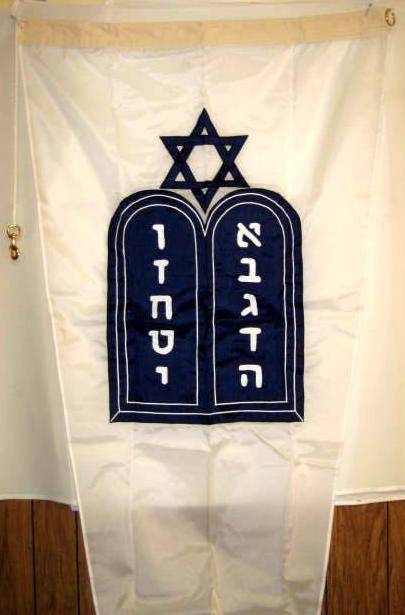
The Jewish worship pennant was approved by the Secretary of the Navy in December 1975 as the equivalent of the traditional church pennant used for Christian services. It is flown above the ensign at the ensign staff (not underway) or gaff (underway) while Jewish services are being conducted aboard a warship by a naval chaplain. The pennant is white with a rounded tip and the emblem of the Jewish chaplaincy--the tablets of Moses surmounted by the Magen David all outlined in dark blue--set with the top toward the hoist.
Jewish Women in the Navy
The history of women serving in the United States Navy began in the Civil War when nuns of the Roman Catholic religious orders came aboard hospital ships to assist the wounded. While the first trained nurses served in the Navy during the Spanish-American War, it was not until 1908 that the Navy Nurse Corps was officially established and produced over 12,000 women who served during World War I. The Navy "WAVES" or Women Accepted for Volunteer Emergency Service force was officially established on July 30, 1942. The WAVES were created to initiate a rapid buildup of Navy personnel at the outset of WWII to address an acute shortage of manpower. With the establishment of a women's reserve force, Congress hoped to enlist a total of 10,000 women and 1,000 officers to aid in the war effort.
Bernice Sains Freid, Bebe Koch,and Lt. Miriam "Mimi" Miller each served in the Navy WAVES during World War II. Miranda Bloch represents one of the first Jewish women in the Marines and Cindy Gats served in the Marines during Operation Desert Storm.
more at Jewish Woman's Archieve
Bernice Sains Freid, Bebe Koch,and Lt. Miriam "Mimi" Miller each served in the Navy WAVES during World War II. Miranda Bloch represents one of the first Jewish women in the Marines and Cindy Gats served in the Marines during Operation Desert Storm.
more at Jewish Woman's Archieve
Rabbi Douglas
Not long ago the Jewish people celebrated Rosh Hashana, the new year, 5770. Wow! That's a long time. I am not very religious, but it reminded me of an incident that happened when I was filming the movie, "In Harm's Way". I played a naval officer, a bitter flier under John Wayne's command. After raping Jill Harworth, the girlfriend of Wayne's son, played by Brandon de Wilde, I sacrificed myself on an air mission.
The most exciting thing about the production was that we got to shoot on the USS St. Paul, a cruiser, as it sailed from Seattle to Hawaii. And there was Otto Preminger, the director, treating the personnel like his own personal crew, the boat like a prop, yelling to the captain, in his German accent, "Push the boat the other vey, so ve get the sunlight!"
I shared a bunk with one of the officers, Josh Nelson, who I was surprised to learn was Jewish. I never think of naval officers as being Jewish, maybe because I didn't know any others when I was one. I asked Josh if many of the crew were Jewish.
He said, "A few."
I said, "Do you ever hold religious services?"
"I tried to, but it's hard to get them interested enough."
"Suppose I conduct the religious service?"
"would you? Could you?"
"Yes," I said, "Why don't you tell your friends that tomorrow, Friday night, I'll conduct the service."
That Friday evening, we were all dining at the captain's table - John Wayne, Burgess Meredith, and of course Otto Preminger - when over the loudspeakers:
NOW HEAR THIS MEN, AT 20:00 THERE WILL BE FRIDAY EVENING JEWISH RELIGIOUS SERVICE CONDUCTED BY KIRK DOUGLAS.
Well, this caused a little ripple. Heads everywhere bobbed. And I, very dignified and nonchalant, stood up and said, "Would you excuse me, Captain? I have to officiate at this service." John Wayne and Burgess Meredith, curious, came over later. Otto Preminger, a Jew, didn't. In a borrowed yarmulke and prayer shawl, I conducted the Friday evening service, remembering the old Hebrew prayers that I learned when I was a poor boy living in Amsterdam, when the people in my synagogue wanted little Issur to become a rabbi, and I didn't know how to tell them I wanted to be an actor. That night on the USS St. Paul was the fulfillment of my debt to them.
I don't think it matters what religion you follow as long as your faith tells you to care for others.
Kirk Douglas
The most exciting thing about the production was that we got to shoot on the USS St. Paul, a cruiser, as it sailed from Seattle to Hawaii. And there was Otto Preminger, the director, treating the personnel like his own personal crew, the boat like a prop, yelling to the captain, in his German accent, "Push the boat the other vey, so ve get the sunlight!"
I shared a bunk with one of the officers, Josh Nelson, who I was surprised to learn was Jewish. I never think of naval officers as being Jewish, maybe because I didn't know any others when I was one. I asked Josh if many of the crew were Jewish.
He said, "A few."
I said, "Do you ever hold religious services?"
"I tried to, but it's hard to get them interested enough."
"Suppose I conduct the religious service?"
"would you? Could you?"
"Yes," I said, "Why don't you tell your friends that tomorrow, Friday night, I'll conduct the service."
That Friday evening, we were all dining at the captain's table - John Wayne, Burgess Meredith, and of course Otto Preminger - when over the loudspeakers:
NOW HEAR THIS MEN, AT 20:00 THERE WILL BE FRIDAY EVENING JEWISH RELIGIOUS SERVICE CONDUCTED BY KIRK DOUGLAS.
Well, this caused a little ripple. Heads everywhere bobbed. And I, very dignified and nonchalant, stood up and said, "Would you excuse me, Captain? I have to officiate at this service." John Wayne and Burgess Meredith, curious, came over later. Otto Preminger, a Jew, didn't. In a borrowed yarmulke and prayer shawl, I conducted the Friday evening service, remembering the old Hebrew prayers that I learned when I was a poor boy living in Amsterdam, when the people in my synagogue wanted little Issur to become a rabbi, and I didn't know how to tell them I wanted to be an actor. That night on the USS St. Paul was the fulfillment of my debt to them.
I don't think it matters what religion you follow as long as your faith tells you to care for others.
Kirk Douglas
Saturday, September 5, 2009
Obituary: Yossi Harel
Yossi Harel, who renamed the rickety ship he commanded Exodus 1947 and sailed it to legend as a symbol of the righteousness of the mission by Jews to settle Palestine in the face of British opposition, died Saturday at his home in Tel Aviv. He was 90.
His death of a heart attack and burial were widely reported in the Israeli news media.
Britain, which controlled Palestine under an international mandate, had in 1939 restricted the number of Jews it would allow to move there to 75,000 over five years, a tiny figure compared with the number who were desperate to go there. Partly because of pressure from Arab countries, Britain held fast to this pre-World War II limit, even as Holocaust survivors tried to go to a biblical homeland.
Harel commanded the main clandestine operations bringing immigrants to Palestine and personally delivered 24,000 of them, a quarter of the total. He is particularly remembered for his command of four large ships. He named one Exodus to recall the Jews' escape from Egypt.
The Exodus never made it to the Palestinian shore. But it made a dazzling sight as it approached the port of Haifa. Loudspeakers blared "Hatikvah," which would become Israel's national anthem. What would be Israel's flag snapped in the wind.
It was there that British forces boarded the boat and engaged in a violent encounter with Holocaust survivors, leaving three Jews dead and hundreds injured. The unintended symbolism could not have been stronger: the British used tear gas and delivered the Jews to an old Nazi SS camp near Hamburg. The events caused wide outrage and prompted support for the Zionist dream.
This vivid tale quickly assumed the mythic power in the Israeli independence struggle that the Boston Tea Party had in America's. It was turned into "Exodus," a popular 1958 book by Leon Uris, which two years later became a film directed by Otto Preminger. Paul Newman portrayed Harel, who was called Ari Ben Canaan in the movie.
Yoram Kaniuk, an Israeli author, wrote in a biography of Harel that the state of Israel was established not in May 1948, when independence was declared and the British left, but on July 18, 1947, when the Exodus valiantly sailed toward certain confrontation in the port of Haifa.
"The state of Israel came into existence before it acquired a name, when its gates were locked to Jews, when the British fought against survivors of the Holocaust," Kaniuk wrote in a biography of Harel, "Commander of the Exodus" (2000).
Yossi Harel was born Yossef Hamburger on Jan. 4, 1918, in Jerusalem; he and his twin brother represented the sixth generation of his family to be born there. The Guardian reported in its obituary that he had a troubled youth, and, after a series of labor jobs, he left his family at 14 to join the Haganah, the Jewish paramilitary organization that later became the core of Israel's military. Kaniuk called him a "Zionist cowboy" in his book.
Harel joined the British Army during World War II and was badly injured in fighting in Greece. He then worked to transport as many Jews to Palestine as possible, legally or illegally. The Daily Telegraph reported that in mid-1946 he was sent on a secret mission to provide agents in Greece with gold to use in bribing European governments to speed up the transit of Jews to Palestine.
Exodus 1947 began as the merchant vessel President Warfield, which was being scrapped after service for both the British and Americans in World War II. It was secretly purchased by Haganah and left Baltimore on Feb. 25, 1947. Yossi, whom Haganah had earlier ordered to study coastal navigation, took command at an Italian port. The refugees boarded at Sète, France, on July 12.
Six days later came the confrontation with the British. At first Yossi encouraged resistance, but then surrendered to prevent further casualties. The next day, members of a United Nations special committee overseeing developments in Palestine watched refugees being transferred to British ships for return to Europe. The committee recommended that the British mandate end and a Jewish state be established. The United Nations General Assembly authorized this on Nov. 29, 1947.
Harel was a bodyguard for Chaim Weizmann, Israel's first president, a top official in Israel's post-independence navy and then a naval architecture student in the United States. Various Israeli and British news reports said he studied naval architecture or engineering in Los Angeles or at the Massachusetts Institute of Technology.
In 1954, Moshe Dayan, chief of staff of the Israeli Defense Forces, called him back to Israel to head Unit 131, a secret Israeli group that had spies in Arab countries. His immediate task was to clean up after a botched Israeli plot to carry out bombings in Egypt to persuade the British and Americans that they could not afford to withdraw from Egypt.
The Telegraph said he went on to pursue a successful business career, which also served as a cover for continuing work for Israeli intelligence.
Harel is survived by three children, eight grandchildren and eight great-grandchildren, The Jerusalem Post reported.
In a speech in La Jolla, California, in 2005, Harel gave statistics to show that running the British blockade was deadlier than Israel's war for independence. He said that 6,000 of 40,000 to 100,000 Jews who fought in the war were killed, or 1 percent. Of the 100,000 who tried to get through the blockade, 3,000 died, or 3 percent.
"With all these casualties, they kept coming, they didn't stop," he said. "A nation destroyed was coming back to life."
Subscribe to:
Posts (Atom)

